April 22, 2011

Jane Eyre by Charlotte Bronte...Initial Thoughts...

April 22, 2011 3
I have read about a third of Jane Eyre, the classic I never intended to read, and so far...so-so. The novel opens with Jane looking back on her life at age 10. Her parents are deceased and she has been living in the home of her Uncle Reed who, on his own death-bed, forced his wife to promise to continue to look after Jane. She is provided with material comforts, but is treated cruelly and starved for affection. She is reminded each and every day just how unwanted she is in the Reed's world. Ultimately, she is shipped off to a school for orphans. At least here, Jane meets companions and receives an education; however, the girls are often literally starving and there is a typhus outbreak that results in the death of many students. Eventually, the conditions at Lowood are exposed and improved. Jane excels academically and at age 18, she joins the cast of characters at the home of Mr. Rochester as governess.

Initially, I fell in love with Jane's feisty character (the scene where she stands up to Mrs. Reed!!!), but her time at Lowood appears to have dampened some of her original fire. Perhaps this is just a natural maturing. I became bored by much of the story in this first third. I was struck with a "blah" feeling that reminded me of Jane's simple, "blah" appearance. Is this where the term "plain Jane" originated from? However, things seem to finally be picking up. Someone has tried to burn Mr. Rochester alive by setting his bed on fire and there is much mystery surrounding one Grace Poole. The mention of Poole brings me to one of the reasons why I decided to read this novel in the first place: I had heard that it held similarities to Rebecca, by Daphne du Maurier. I found they both start rather slow, involve a mansion shrouded in mystery with an eerie portion of the home that isn't used and include a whack job character on the house staff. Also, in both cases, the narrators are reflecting on their past. Will the similarities end here? Will Jane return to her former feisty glory? Ok, I am intrigued enough to read on...

March 31, 2011

Journaling?

March 31, 2011 1
Since starting this blog (as a reading journal of sorts), I have been contemplating keeping a personal journal as well. I kept a diary at different times in my youth. As an adult, I often wanted to start journaling again, but all the thoughts that swirl around in my head never seem to make it to paper. I get lost in the details of this idea. I like the idea of a regular pen and paper journal, but I hate my handwriting. Should I keep my journal on my laptop because there will be spell check and an orderly font? Will someone betray my trust and help themselves to my private thoughts (which happened to me as a child)?

Do you journal (outside of your blog)? Do you keep a notebook, a fancy cloth bound journal, or a computer document?


March 30, 2011

Poetry?

March 30, 2011 0
Poetry. I do not know much about the various mechanics involved in poetry. Reading poetry scares me and often makes my head hurt. In truth, I have not read much poetry, but I hope to eventually change this. In The Vintage Book of American Women Writers anthology, edited by Elaine Showalter, I found "What Lips My Lips Have Kissed" by Edna St. Vincent Millay to share:

What my lips have kissed, and where, and why
I have forgotten, and what arms have lain
Under my head till morning; but the rain
Is full of ghosts tonight, that tap and sigh
Upon the glass and listen for reply;
And in my heart there stirs a quiet pain
For unremembered lads that not again
Will turn to me at midnight with a cry.
Thus in the winter stands the lonely tree,
Nor knows what birds have vanished one by one,
Yet knows its boughs more silent than before:
I cannot say what loves have come and gone;
I only know that summer sang in me
A little while, that in me sings no more.

What is your favorite poet? What is your favorite poem?

February 26, 2011

Who's Afraid of Virginia Woolf by Edward Albee

February 26, 2011 2
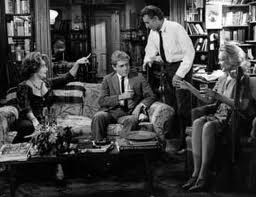
From 1966 movie adaptation of the play
starring Elizabeth Taylor
and Richard Burton.
Initially, all I could think during and after reading Who’s Afraid of Virginia Woolf, a 1962 play by Edward Albee, was “What the hell?” George and Martha, a long married couple, return home from a university faculty party and the sparks begin to fly…sparks that are definitely not of the good variety. George and the reader learn that the young new biology professor, Nick, and his wife, Honey, have been invited over for some post party cocktails by Martha. It is after two o’clock in the morning and George is pissed. More sparks fly and the fighting continues to escalate right in front of the company. These two were making me incredibly uncomfortable, to say nothing of Nick and Honey. By the end of the play, the situation has gotten completely out of hand. I went from initially thinking that George and Martha were just acting like loons because they were drunk to thinking that perhaps they (or at least Martha) were mentally ill.

I was so distracted by their behavior that I originally missed much of the symbolism and intention of this work so, I actually had to give this play some extra thought. Albee certainly succeeded in creating an interesting character study. I would really like to see this on the stage. I think that it is important to remember that this play was originally being viewed by individuals who were just leaving the warm clutches of the wholesome 1950s. A time when shows like Leave it to Beaver depicted the "white picket fence" American family on TV. A world where everything was all “golly Wolly” and “geez Beav” and June and Ward were all smiles even during the rare disagreement. Albee was perhaps trying to expose this as a façade. That many Americans did not necessarily have their polite “telephone voices” turned on all the time. That life was gritty, complicated and imperfect and that for those that were hiding behind the facade ultimately illusion was a dangerous game. Albee is scrutinizing not only how some people project false images in public but also how this occurs in more intimate relationships such as between husbands and wives. Albee also explores how the frustration of the lack of children, the lack of career success for a man, and the unavailability of career options for women during this time can affect marriage. The image of the ideal successful American family required that certain expectations be met. A family required the perfect working dad, house wife and mother, children, house, and car. One must keep up with the Jones next door. This play reminded me in some ways of Richard Yates’ novel Revolutionary Road which is a haunting tale of the dangers of chasing the idealistic American dream. I think it would be interesting to explore these two works together in an upper high school English class. Ultimately, I think this play is something that must be experienced live rather than read.

February 25, 2011

More Bookstore Adventures...

February 25, 2011 4
My daughter is on winter break this week. Today the snow is flying, but yesterday we made it out to lunch and a movie and stopped in to the only used book store in my area. I had 5 selections that I had decided to trade in and we came home with 6 new selections with $0 spent! I found clean, like new copies of The Moonstone by Wilkie Collins (which was my favorite find of the day), The Mill on the Floss by George Eliot (because it was such a nice used copy and Allie has such good things to say), The Lion, the Witch and the Wardrobe by C.S. Lewis, and The Curious Incident of the Dog in the Night-time by Mark Haddon. Exciting, but perhaps it is time to stop adding to the TBR pile and start reading!!! :)
 
◄Design by Pocket. Premium Wordpress Themes | Premium Blogger Templates►